
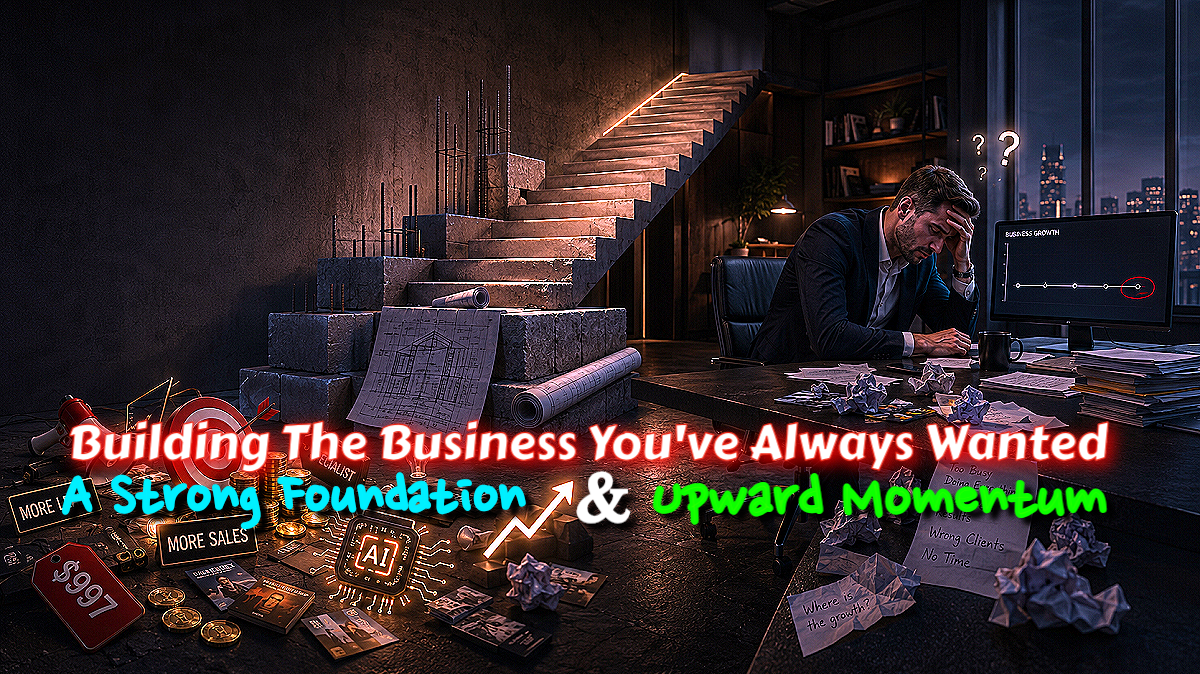
Building The Business You
Always Wanted To Have
“You do not build the business you really want by reacting forever.
You build it by strengthening the fundamentals, installing strategy,
and creating momentum on purpose.”
Dave Smith, IMJustice Marketing
There comes a point where hustle, instinct, effort, and personal drive are no longer enough.
They may have helped the business survive. They may have helped it get through the early
years. They may have helped the Business Owner create customers, revenue, and opportunity.
But eventually, the same approach that helped the business get started can begin to create
pressure, inconsistency, exhaustion, and even chaos.
That is when the deeper questions begin to surface.
Why do I always have to compete on price? Why do I keep attracting the wrong clients?
Why do prospects go silent? Why does nobody remember my brand? Why is revenue so
inconsistent? Why does my Marketing not work the way I thought it would?
Those questions are not random. Many times, they are warning signs that the business
has outgrown hustle, but has not yet installed the fundamentals, foundation, structure,
and Strategic Marketing needed to create stronger momentum.
The good news is that this can be addressed. A Business Owner does not have to keep
reacting forever. With the right advice, guidance, and Expert perspective, it becomes
possible to step back, examine what is missing, strengthen the foundation, and start
building the business with more purpose, more direction, and more control.
My business survived the first 5 years on hustle and gut instinct.
Now we are at $1M in revenue and I feel like I’m running a circus.
What foundational Marketing principles do I need to install first
before I scale?
This is a very common turning point. The business has grown, but the way it grew may not be
strong enough to support the next level. At $1M in revenue, the Owner may have customers,
employees, vendors, responsibilities, overhead, and pressure that did not exist in the early days.
What once felt like momentum can begin to feel like a circus because too much is still dependent
on reaction, instinct, memory, and the Owner holding everything together.
Before scaling, the business needs to perfect the
fundamentals that make growth more predictable.
It must know who it is really trying to serve, what makes it meaningfully different, why that matters
to the right prospect, how prospects make decisions, what message needs to be communicated,
how interest turns into a buyer, and how Marketing and Sales should work together. And, are we
innovating?
Scaling chaos only creates bigger chaos. Scaling a fundamentally sound foundation creates the
possibility for stronger revenue, stronger profit, and a business that becomes easier to understand
and improve.
I have a great product, but my pricing is all over the place. How do I
align my pricing strategy with my brand positioning to increase profit
margins without losing customers?
Pricing problems are rarely just math problems.
A Business Owner may think the issue is what the market (or their customers or clients) will “allow”,
but many times the real issue is strategic positioning. If the business has not clearly established why
it is different, why it is valuable, and why the right customer should choose it over a cheaper option
(or anyone else), price becomes one of the easiest things for the prospect to question.
Increasing profit margins is not about greed.
It is about building a business that can afford to serve people properly, deliver better value, improve
the customer experience, and stop attracting customers who only care about the cheapest option.
When pricing is aligned with positioning, the business can begin to filter better. It can attract stronger-fit
clients, reduce discount pressure, and create more room for service, quality, follow-up, and growth.
But if the message does not justify the price, the market will push back.
I want to stop being the “face” of my business and build a brand that
attracts clients without me. What is the 12-month strategic roadmap
to make that happen?
When the Owner is the brand, the business can grow, but it can also become trapped.
Every relationship, sale, referral, trust point, decision, and opportunity may run through one person.
That can feel flattering at first, but over time, it becomes exhausting. The business cannot fully scale
if the marketplace only trusts the Owner and not the company, the process, the message, the team,
or the brand.
The roadmap begins by transferring trust from the person to the business.
That means the brand must communicate what it stands for, who it serves, what problems it solves,
what makes it different, and what the customer can expect without the Owner personally explaining
everything.
The business needs stronger messaging, informational and educational Marketing material,
a documented Sales Process, consistent follow-up, stronger proof of expertise, and a way for
the team to represent the brand without watering it down.
The goal is not to remove the Owner’s influence. The goal is to stop making the Owner the only
reason prospects trust the business.
How do I align my sales team and my Marketing team so they stop
fighting over leads and start working toward the same revenue goals?
Sales and Marketing often fight because they are not operating from the same understanding.
Marketing may believe it is generating leads. Sales may believe the leads are weak. Marketing
may blame follow-up. Sales may blame lead quality. Meanwhile, the Business Owner is stuck in
the middle, wondering why both sides are busy, but revenue is not moving the way it should.
Alignment begins by defining what a good opportunity actually looks like.
Both teams need to understand the target or ideal customer, the message that attracted them,
the problem(s) they are trying to solve, the stage of decision-making they may be in, and what
should happen after they raise their hand.
Marketing should not simply create activity.
Sales should not simply wait for perfect buyers.
Both sides need to work from the same strategy, the same language, the same expectations,
and the same revenue and profit goals. When that happens, leads stop being something to
argue about and become something to manage, improve, and convert.
I’m exhausted from trying to do everything myself. How do I build a
Marketing infrastructure that runs smoothly, even when I step away
from the day-to-day?
Owner exhaustion is often a sign that the business is relying too much on personal involvement
and not enough on infrastructure.
The Owner may be making too many decisions, approving too many details, fixing too many
problems, answering too many questions, and carrying too much of the Marketing and Sales
thinking alone.
That is not sustainable, and it is usually not scalable.
A smoother Marketing infrastructure does not start with more software, more tools,
or more people. It starts with documented thinking.
Who is the business trying to reach? What should be communicated?
What offers are being made? What follow-up should happen?
What happens when someone shows interest? What should be measured?
What content supports trust? What materials educate the prospect?
What does the team need to know so they can execute with purpose instead of guessing?
Once those answers are documented, the Owner can begin to delegate execution without
giving up strategic control.
Conclusion
The Foundation & Momentum stage is where the Business Owner starts realizing that growth cannot be built on reaction forever. Hustle may have started the business, but fundamentals are what help build something stronger.
Gut instinct may have created early wins, but strategy is what helps create consistency. Activity may keep the business busy, but a fundamentally sound foundation is what gives that activity direction.
This is where my work becomes especially important.
I do not sell Marketing gimmicks, random tactics, or agency-style activity dressed up as progress. I help Business Owners understand what should be done, why it matters, and what must be strengthened underneath the Marketing, Sales Process, messaging, positioning, and revenue goals.
Because the business they really want is not built by reacting to everything that comes along. It is built by creating the foundation, structure, and momentum to grow on purpose.
If these questions exposed gaps you were not expecting, or confirmed frustrations you have already been feeling, My Strategic Reveal and Overview may be the right next step. It is not a sales call. It is an Advanced Discovery Session where you answer 6 strategic questions, I review them, and we have a conversation about where your business may be vulnerable, where unseen gaps may exist, and where revenue and profit may be getting limited.
No pitch … No pressure … Just intel …
.
.
Helpful strategic resources on my sidebar
Explore my Special Offers, including The Snapshot, The Business Coaching Manifesto,
Mastering The Sales Process, and other resources designed to help you see your
business growth challenges from a more strategic perspective.
OR
If what you just read feels familiar, consider two simple next steps.
The Strategic Reveal and Overview is the no-cost first step. You answer 6 strategic questions,
I review them, and we have a no-pressure conversation about where your business may be
vulnerable, where unseen gaps may exist, and where revenue and profit may be getting limited.
The Flash Diagnostic is the deeper paid step. It goes much further, with a more detailed look at
the fundamentals, gaps, leaks, Sales Process, and Strategic Marketing issues that may be
holding the business back.
No pitch … No pressure …
Just a smarter way to find out what may really be limiting your growth.
.
.
